Choosing a finish for metal event furniture involves more than matching a color swatch. Chairs, cocktail tables, stages, and display frames face repeated handling, transport, spills, sunlight, and sudden weather changes. A weak finish can chip around a leg joint before the first season ends. A suitable powder coating should protect the steel or aluminum while preserving the furniture’s visual identity.
Why is powder coating essential for metal event furniture? The answer begins with durability. Powder is electrostatically applied, then cured into a continuous film inside a heated oven. This process can create strong adhesion, consistent coverage, and a clean surface without the runs often seen in liquid paint. Kevin Coursin, a respected powder-coating educator, states, “The finish is only as good as the preparation beneath it.” That reminder matters. Degreasing, abrasion, pretreatment, and correct curing temperatures often determine whether the coating survives busy rental cycles.
Look closely at the details. A matte black frame hides fingerprints better than glossy black. Textured powder can disguise minor handling marks. Zinc-rich primers may help protect steel where moisture is a concern, although they add cost and process time. Aluminum needs a different preparation strategy. One choice does not fit every venue.
There is no perfect finish. Even premium powder coating can fail after sharp impacts or poor storage. That part is easy to overlook. Buyers should ask for coating thickness, pretreatment details, cure records, color stability, and sample panels. A small test can reveal more than a polished brochure.
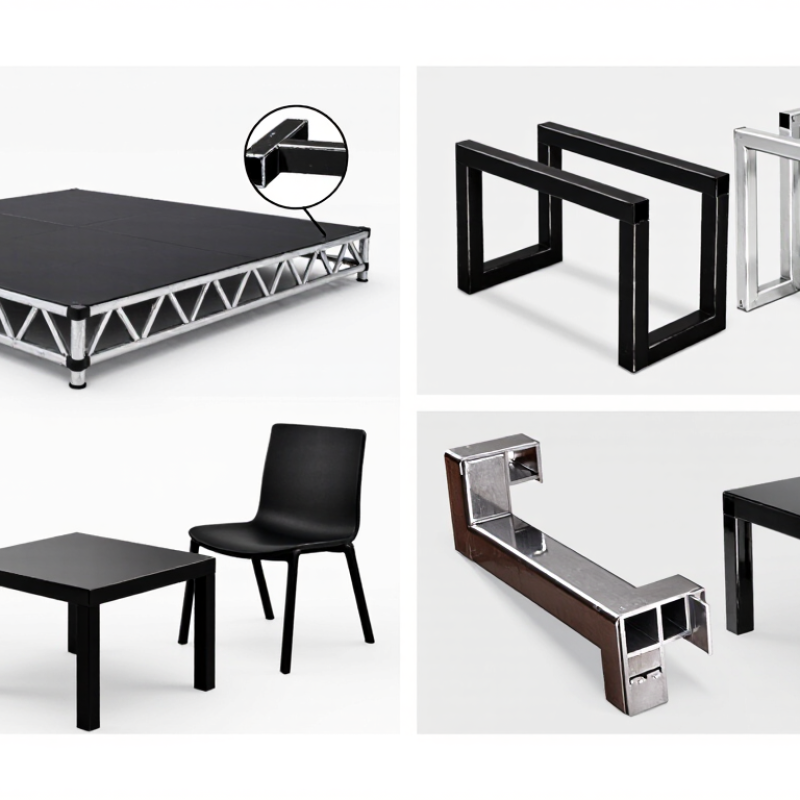
How to Choose Powder Coating for Metal Event Furniture?
Event furniture must handle repeated loading, transport, assembly, and cleaning. Define these demands before selecting a powder coating system. A cocktail table may carry light items, while a folding bench needs stronger resistance around joints and edges. Inspect welds, corners, and contact points carefully. These areas often receive the most impact.
Choose the finish according to use and appearance. Smooth, low-gloss coatings can hide minor marks better than high-gloss surfaces. Textured finishes may improve visual depth, but they can trap dust and require more careful cleaning. For outdoor events, confirm resistance to ultraviolet exposure, moisture, and temperature changes. Indoor furniture still faces abrasion from stacking and frequent handling. A coating suitable for a showroom may fail after several busy event seasons. That mistake is easy to make.
Tips: Record the expected load, cleaning method, storage conditions, and exposure time. Request technical data for adhesion, hardness, and weather resistance. Test a coated sample on the actual metal, especially around welds and folded edges. Check color under event lighting, not only in the workshop. A small test panel can reveal poor coverage, sharp-edge thinning, or an unsuitable texture before production. Consider repair needs too. A finish that looks excellent but cannot be touched up easily may create unnecessary replacement costs. Reflect on the real workflow, not the ideal one.
How to Choose Powder Coating for Metal Event Furniture?
Metal event furniture faces changing conditions: indoor venues, humid storage rooms, outdoor terraces, and frequent transport. Polyester powder is usually the safest choice for mixed environments. It offers strong ultraviolet resistance and better color retention than epoxy. The American Architectural Manufacturers Association’s AAMA 2604 and 2605 standards use multi-year outdoor exposure tests to evaluate weathering, color change, and chalking. These criteria matter when chairs remain under sunlight for long periods.
Epoxy provides excellent adhesion and chemical resistance. It suits indoor tables, display frames, and furniture exposed to cleaning agents. However, direct sunlight can cause chalking and fading. Hybrid powder combines epoxy and polyester properties. It performs well indoors, especially where appearance and corrosion resistance must balance. Outdoor use remains risky unless the formulation has verified weathering data.
The U.S. Environmental Protection Agency’s AP-42 guidance identifies powder coating as a very low-VOC finishing process, supporting its practical use in event-furniture production. A 2024 Grand View Research report also projected continued powder-coating market growth of about 6.6% annually through 2030. That growth does not make every powder suitable. A practical mistake is choosing by color alone. Request ASTM B117 salt-spray results, ASTM D2247 humidity testing, and documented UV exposure data. Test the complete furniture system, including pretreatment, steel edges, welds, and fasteners. Small gaps often fail first.
Choosing powder coating for metal event furniture requires more than selecting a color or surface texture. The coating must resist frequent handling, stacking, transport, and occasional outdoor exposure. For many steel tables, chairs, frames, and display stands, a dry film thickness of 60–80 μm offers a practical working range. Thinner films may leave sharp edges and welds poorly protected. Excessively thick films can affect appearance, curing, and assembly fit.
Measure the cured coating with a calibrated, nondestructive gauge following ASTM D7091 procedures. Check the gauge on suitable reference shims before inspection, then take several readings across each part. Include flat panels, corners, tube ends, welded joints, and hidden contact areas. One reading is not enough. Record the average and the spread between readings, because a single high result can hide thin areas. Keep the probe clean and hold it perpendicular to the surface. Small errors happen.
Coverage is not perfectly uniform.
Event furniture often has complex geometry, and powder can build up near corners while leaving recessed zones lighter. I have seen attractive panels fail inspection because their underside measured only 42 μm. That result required adjustment, not excuses. Recheck after application changes, especially when grounding, spray distance, or part temperature changes. ASTM D7091 helps verify measurement accuracy, but it does not replace visual inspection, adhesion checks, or proper curing control. A reliable specification should state the target range, sampling locations, gauge method, and acceptable variation.
Choosing powder coating for metal event furniture requires more than a glossy finish. Chairs, tables, and display frames face repeated handling, stacked storage, spilled drinks, and humid transport. The NACE IMPACT study estimated global corrosion costs at approximately US$2.5 trillion annually, equal to about 3.4% of global gross domestic product. That figure makes corrosion testing more than a laboratory exercise.
ASTM D3363 measures pencil hardness and helps indicate resistance to surface marking. A higher hardness grade is useful, but it does not guarantee impact resistance. ASTM D4060 measures abrasion loss under controlled wheel and load conditions. Compare results only when panels, wheels, loads, and coating thickness match. Small test changes can distort conclusions. In practice, inspect chair edges and folding joints too. They often fail before broad, flat surfaces.
ISO 9227 evaluates corrosion performance through neutral, acetic, or copper-accelerated salt spray exposure. It records rust development, blistering, and creep from a scribe, but the standard itself does not set universal pass limits. Specify exposure hours and acceptance criteria before testing. A 1,000-hour result may look impressive, yet it cannot predict every outdoor environment. ASTM D3363, D4060, and ISO 9227 should be read together, not separately. I would also request duplicate panels and production-thickness checks. One perfect coupon can hide an inconsistent batch. Controls matter.
Representative non-brand benchmark results for common powder-coating systems. Higher pencil-hardness grade and salt-spray exposure indicate better resistance, while lower Taber abrasion mass loss indicates better wear resistance.
ASTM D3363 measures pencil hardness, ASTM D4060 measures abrasion mass loss, and ISO 9227 evaluates corrosion resistance under neutral salt spray. Test conditions, substrate preparation, film thickness, and evaluation criteria should be kept consistent when comparing finishes.
Choosing powder coating for metal event furniture starts with use, not a color chart. Rental tables, folding chairs, and display frames face repeated handling, sunlight, and quick cleaning. I inspect welded corners, tube ends, and contact points before selecting a coating system. These areas often reveal weak coverage first. A durable polyester powder may suit outdoor events, while a tougher hybrid can fit sheltered interiors. Color affects perceived cleanliness. Bright white shows scuffs quickly, while charcoal may reveal fingerprints under event lighting. Request physical panels, not only digital samples.
Powder transfer efficiency above 95% can reduce overspray and improve material use when the line is properly controlled. It still depends on grounding, spray-gun settings, booth airflow, and operator technique. Ask for measured data, test conditions, and routine production results. VOC performance also deserves careful review. Powder systems generally use little or no solvent, but curing energy and pretreatment choices affect the wider environmental profile. Check technical data sheets and independent test records where available. Texture changes maintenance. Fine textures hide small marks, while heavy textures may trap dust around hinges and fasteners. I have seen attractive samples fail after rushed pretreatment. I still get this wrong sometimes. Run a small pilot using real hardware, cleaning agents, and assembly tools before approving the finish.
Consider loading, transport, stacking, assembly, cleaning, and outdoor exposure. Inspect welds, corners, hinges, and contact points carefully. These areas suffer repeated impact.
A dry film thickness of 60–80 μm often provides a practical working range. Thinner films may poorly protect sharp edges and welds. Excessive thickness can affect curing and assembly fit.
Use a calibrated, nondestructive gauge following ASTM D7091 procedures. Check the gauge with reference shims first. Take readings on flat panels, corners, tube ends, welds, and hidden contact areas.One reading is insufficient.
Complex shapes can collect powder near corners while leaving recessed areas thin. Undersides and folded edges deserve special attention. Coverage is not perfectly uniform.
Smooth, low-gloss finishes can hide minor marks better than high-gloss surfaces. Fine textures may conceal small scuffs. Heavy textures can trap dust around hinges and fasteners.
Request physical sample panels, not only digital images. Bright white can show scuffs quickly. Charcoal may reveal fingerprints under strong event lighting. Check samples beside real hardware.
Confirm resistance to ultraviolet exposure, moisture, abrasion, and temperature changes. Test the coating on actual metal. Include welds, folded edges, and exposed frame sections.
Powder systems generally use little or no solvent. Transfer efficiency above 95% can reduce overspray when the line is controlled properly. Curing energy and pretreatment still affect the wider environmental profile.
Test real hardware, cleaning agents, assembly tools, and storage conditions. A small panel can reveal thin edges, poor adhesion, trapped dust, or unsuitable texture. Attractive samples sometimes fail later. I still get this wrong sometimes.
Why is powder coating essential for metal event furniture? It provides a durable, attractive, and environmentally responsible finish that helps furniture withstand frequent handling, assembly, transport, and exposure to changing conditions. The right coating should be selected according to the furniture’s load requirements, usage frequency, desired appearance, and indoor or outdoor exposure. Polyester is generally suitable for exterior applications, epoxy offers strong adhesion and chemical resistance for indoor use, while hybrid systems can balance performance and cost in controlled environments.
A target film thickness of 60–80 μm can support consistent protection, but coverage should be verified accurately using ASTM D7091. Durability evaluation should include pencil hardness testing under ASTM D3363, abrasion resistance testing under ASTM D4060, and corrosion testing according to ISO 9227 when relevant. Finally, color, gloss, texture, and VOC performance should match the event setting and maintenance expectations. Selecting a powder with transfer efficiency above 95% can also improve material utilization, reduce waste, and promote a more efficient finishing process.

TwinVibe Furniture